Petrushka
Dead SoulsPetrushka, the valet in Paul Ivanovitch Chichikov’s retinue, is a deliberately minor but recurrent figure whose silence and physical comic business give the novel’s journey a domestic counterpoint. He is more often seen smelling, stumbling, being scolded, or following his master than explaining himself. Yet his appearances connect the investigation into Chichikov’s past with the later travels of the unfinished second part, and his last scene places him beside Chichikov at the moment of release.
Identity and Place in the Household
During the provincial officials’ search for information about Chichikov, Petrushka yields almost nothing. The officials’ servants approach the household staff discreetly, hoping to learn the master’s background, but Petrushka provides only an impression of the smell in his living room. Selifan gives the investigators the little factual information they obtain: Chichikov had worked in government service and in Customs. Petrushka’s silence is not turned into a source of secret knowledge; instead, the inquiry ends with the officials still unable to establish who Chichikov is or whether he poses a threat to them.
The narrative returns to Petrushka in a different register when Chichikov, after recovering from a chill and sore throat, prepares to leave his inn. Nozdrev, encountered along the way, mistakes him for a smoker and calls for a man named Vakhramei. Chichikov corrects him: the servant is Petrushka, and he has never had a servant called Vakhramei. This brief exchange makes Petrushka’s identity a small, concrete point of friction in Nozdrev’s loose, unreliable talk, while showing Chichikov briskly defending the details of his own household.
Travel, Work, and Physical Comedy
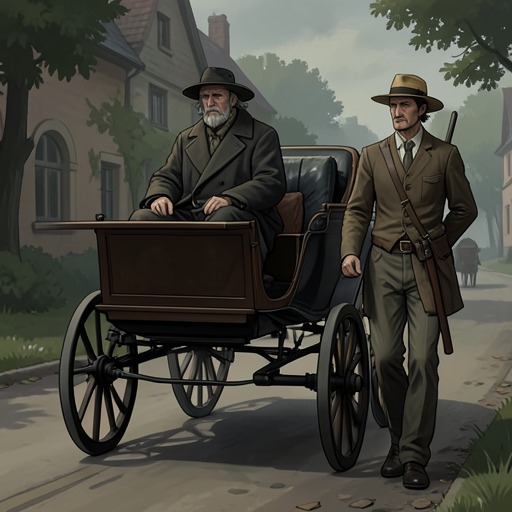
On Chichikov’s departure from the provincial town, Petrushka rides with Selifan in the britchka. Their journey is interrupted by the funeral procession of the Public Prosecutor. Chichikov draws the curtains and keeps out of sight; Selifan and Petrushka remove their caps and watch the cortege pass, under strict instructions not to greet any servants they recognize. The moment gives Petrushka a place within the uneasy traffic between private flight and public ceremony: he follows the master’s orders while the officials, walking behind the hearse, are preoccupied with the incoming Governor-General and their own prospects.
Later, at Tientietnikov’s household, Chichikov’s rooms are put in order, but Petrushka is initially lodged in a small front chamber opening onto the hall. It soon fills with his characteristic smell, and he is moved to the servants’ quarters, where he should have been placed from the outset. The shift is a practical household correction, delivered in the novel’s comic, unsentimental manner: the guest’s comfort and the servant’s presence reorganize the house, while Petrushka’s odor becomes an almost material sign of his arrival.
Petrushka makes himself at home among the estate’s staff. He and Grigory the butler first compete by boasting about travel: Petrushka talks up the places he has visited, while Grigory invokes Saint Petersburg, which Petrushka has never seen. Their rivalry grows more extravagant as Grigory names an imaginary town and assigns it a journey of thirty thousand versts, leaving Petrushka open-mouthed and the household laughing. The contest does not harden into hostility. The two men end by swearing eternal friendship and regularly going together to the village tavern.
Travel also repeatedly exposes Petrushka’s vulnerability to mishap and his stubbornness afterward. On the way toward Colonel Koshkarev’s, Selifan says he could not ask directions amid the clatter of the carriage, but Petrushka had asked the coachman. Chichikov dismisses Petrushka as a fool and suspects he is drunk; Petrushka answers that the route is straightforward once they descend the next hill. Later, branches brush the travelers and repeatedly knock Petrushka’s cap off. He curses both the tree and the landowner responsible for it, but refuses to tie the cap on or hold it steady, confident that the accident will not recur. The small cycle—mishap, complaint, refusal to adapt—turns an ordinary journey into recurring physical comedy.
On the road to Konstantin Theodorovich Kostanzhoglo’s estate, the carriage ride becomes more precarious still. Selifan can hardly keep his seat on the box, and Petrushka falls headlong twice, after which he has to be tied to his perch with a piece of rope. Chichikov’s only comment is that Petrushka is a clown. The episode makes the servant’s bodily misadventure part of the novel’s travel rhythm: the carriage advances toward another estate and another encounter, while the men accompanying it are battered by the practical disorder of the road.
Relations and Contrasts
Petrushka’s relationship with Chichikov is presented chiefly through service, correction, and presence rather than intimacy. Chichikov rebukes him over directions, insults his intelligence, and sometimes treats him as an inconvenience; Petrushka nevertheless remains in the retinue and continues to perform the practical tasks of travel. In the first part, his answer to the officials’ inquiries helps preserve the gap between Chichikov’s public identity and the limited facts others can verify. In the second part, his repeated mishaps make him a comic foil to his master’s concern for polished manners and self-command.
His friendship with Grigory offers a rare reciprocal relationship of his own. Their initial contest over who has travelled farther is sustained by exaggeration and mutual one-upmanship, but it ends not in a winner’s triumph but in a shared routine: friendship, tavern visits, and laughter from the other servants. Petrushka is not only the object of jokes; he participates in the boastful performance that produces them, even when Grigory’s invented destination leaves him bewildered.
Petrushka’s life at Tientietnikov’s estate also contrasts with Selifan’s. Selifan is drawn to the village’s songs and dances, while Petrushka establishes himself through the servants’ social world and his friendship with the butler. Their different responses make the household more than a backdrop for Chichikov’s dealings: the journey brings an entourage whose members find separate forms of amusement and belonging at the estate.
Change and Ending
Petrushka’s circumstances shift as Chichikov’s journey continues. He moves from the inn and the provincial officials’ unsuccessful inquiry to the household at Tientietnikov’s, where he first occupies an ill-suited front room and is then transferred to the servants’ quarters. He acquires a friend in Grigory, but no larger transformation is narrated. Across the available episodes, his defining pattern is continuity: he follows Chichikov, suffers the repeated comic accidents of travel, and remains a servant within a household repeatedly on the move.
His final appearance comes when Chichikov leaves prison. A warder carries Chichikov’s effects as he emerges, and outside he finds Petrushka and Selifan overjoyed to see their master free. Chichikov addresses them kindly and says they must pack and leave. Selifan agrees, adding that the roads should be firmer after the heavy snowfall and that he is weary of the town. Petrushka does not speak in this exchange, but his presence completes the reunion: the servant who has accompanied Chichikov through successive journeys is waiting again at the threshold of departure.
Narrative Function
Petrushka’s recurring entrances supply practical and bodily detail amid plots driven by documents, speculation, and official suspicion. His almost useless contribution to the officials’ inquiry contrasts with the elaborate effort to identify Chichikov; his smell alters the arrangement of Tientietnikov’s house; his knocked-off cap and falls from the carriage interrupt the forward motion of travel. These details delay and diversify the narrative rather than advancing the central transactions, drawing attention to the servants and routines that accompany the pursuit of property and status.
The episodes also keep the novel’s humor close to material circumstance. A servant’s room has to be reassigned; a cap keeps falling; a traveler must be tied to his seat; an extravagant travel boast ends in friendship at the tavern. Petrushka remains lightly characterized, and the evidence does not furnish a private history or independent ambition. His significance lies instead in recurrence: as Chichikov’s entourage moves from one household and crisis to another, Petrushka’s quiet, comic presence makes the journey feel lived in, and his silent welcome at the prison gate carries the continuing household into the story’s abrupt, unresolved onward movement.